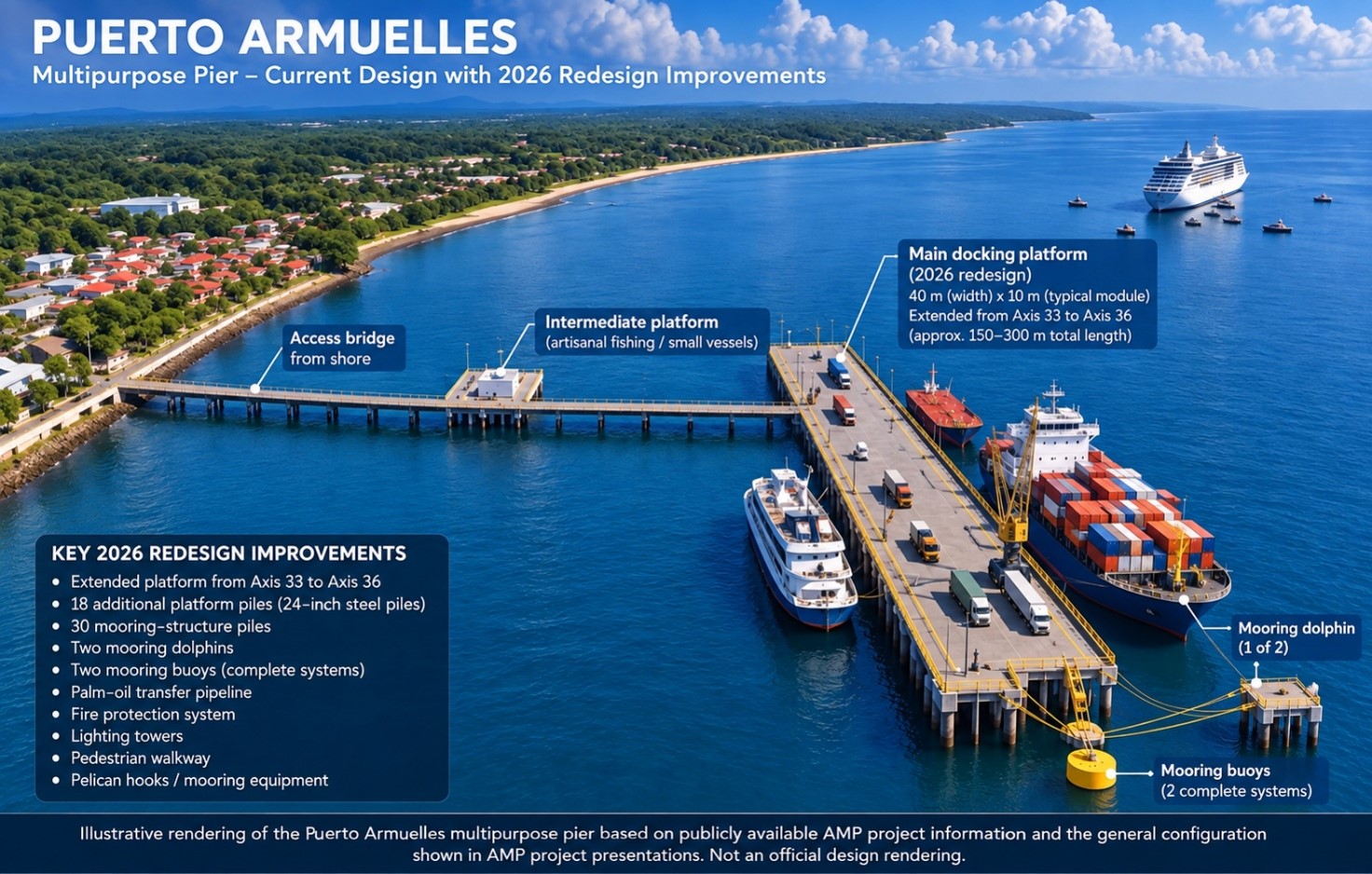
Here is an illustrative rendering of the Puerto Armuelles multipurpose pier, based on publicly available AMP project information and the general configuration shown in AMP project presentations. *Not an official design rendering.
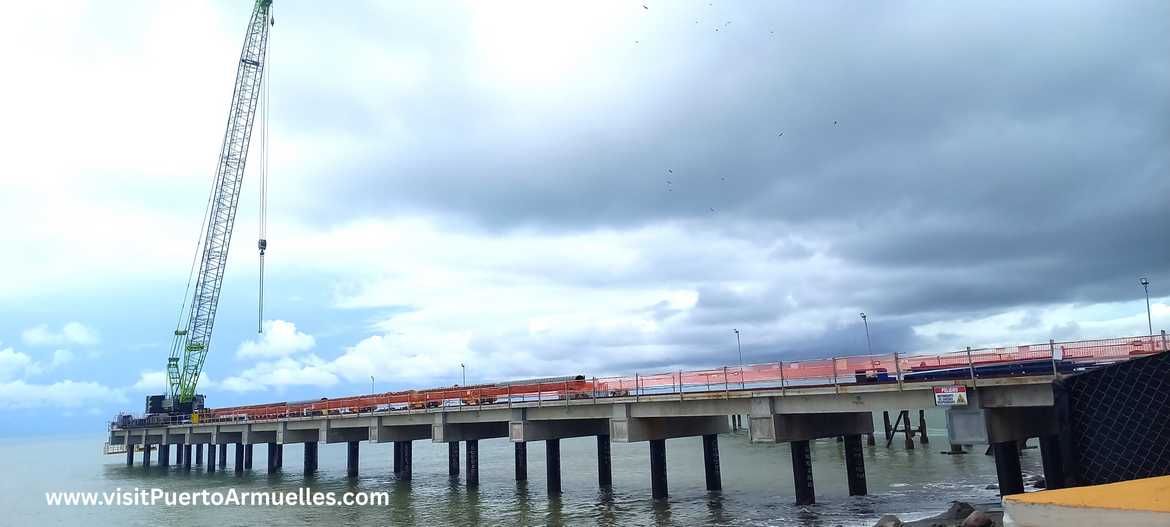
 When we last wrote about the Puerto Armuelles Multipurpose Port Terminal, the story was about momentum: construction of the new pier at 72% physical progress, a $10.2 million addendum awaiting the Comptroller’s endorsement, and the Panama Maritime Authority (AMP) in conversation with at least a dozen companies interested in setting up operations here.
What was harder to picture was the pier itself. So we have put together an illustrative rendering, drawn from publicly available AMP project information and the general configuration shown in the AMP project presentations, to show how the various pieces fit together and gives a sense of the scale and layout of what is being built at the end of our waterfront.
From Fishing Dock to Multipurpose Berth
The most important thing to understand about the 2026 redesign is that it is not a cosmetic change. The earlier concept relied on a floating pontoon. The current construction information describes something considerably more substantial: a fixed docking platform, 40 meters wide with a typical 10-metre module, supported on 24-inch steel piles. That is a fundamentally different class of structure: one built for cargo handling rather than for small craft tying up alongside.
AMP describes the planning as contemplating infrastructure of roughly 150 to 300 linear meters, capable of receiving ships of 300 to 330 meters in length with up to 13 meters of draft.
For anyone who has watched the bay for the last twenty years, those numbers deserve a second look. Vessels of that size are not fishing boats. They are feeder container ships, general and dry cargo vessels, liquid bulk carriers, and cruise ships.
What the Addendum Adds
Addendum No. 1 in the bid extends the platform from Axis 33 to Axis 36 and adds a specific list of elements. The works include:
- 18 additional platform piles and 30 piles associated with the mooring structures
- Two mooring dolphins and two complete mooring buoy systems, allowing larger vessels to be held safely alongside
- A palm-oil transfer pipeline, connecting the region’s agricultural production directly to the berth
- A fire protection system, lighting towers and pelican hooks and associated mooring equipment
- A pedestrian walkway for visitors
- Additional design and engineering work, and a master plan
That last pair of items matters more than it might appear. A pedestrian walkway is not something you build for a working cargo dock alone.
It is something you build when you expect people – visitors, passengers, residents – to come out onto the pier.
Uses AMP has Named
AMP has been specific about what it expects the facility to handle:
Container feeder vessels · dry and general cargo · liquid bulk · palm oil · cruise activity · fishing
The intermediate platform in the design is set aside for artisanal fishing and small vessels. It’s great to know that the people who have worked these waters for generations are part of the plan, not displaced by it.
But alongside them, the pier is being configured to do several other jobs at once — which is what “multipurpose” means, and why the redesign was necessary.
There May be More to Come
On 23 September 2026, AMP and the Inter-American Development Bank (IDB) disclosed that they are now reviewing conceptual designs for a further expansion of the redesigned platform. AMP has not disclosed the dimensions, cost, funding or final configuration of that additional expansion, and it has not been approved for construction – what has been confirmed is that the work is under study.
The master planning process is looking at technical alternatives and conceptual designs for the “next stage,” and is also examining road connectivity, the logistics hinterland and palm-oil demand — in other words, not just the pier, but everything that would need to feed into it and move out from it. That is the sign of a project being planned as a system rather than as a single structure.
Why This Matters for Puerto Armuelles
A 40-metre-wide fixed platform on steel piles, capable of taking a 330-metre vessel at 13 meters of draft, with a palm-oil line running down it and a walkway alongside, is a meaningfully different proposition from what Puerto Armuelles has had before. It is infrastructure that a shipping line can actually use. It is infrastructure that gives the region’s palm-oil producers a direct export route. And it is infrastructure that cruise operators could consider calling at. Whether all of that materializes depends on the things it always depends on — the Comptroller’s endorsement, the conversion of investor interest into signed commitments, and the quality of the master plan now being drawn up. But the physical facility taking shape at the end of the viaduct is being built to a specification that makes those conversations possible.
It is no longer a question of whether the pier gets built –
it is increasingly a question of how much use our community can make of the opportunity.
Read more: La Prensa’s report on the redesign and the 72% progress figure — “AMP rediseña muelle de Puerto Armuelles mientras obra alcanza 72% de avance” (21 August 2026, in Spanish)
Read more about the new dock expansion & investment HERE.


