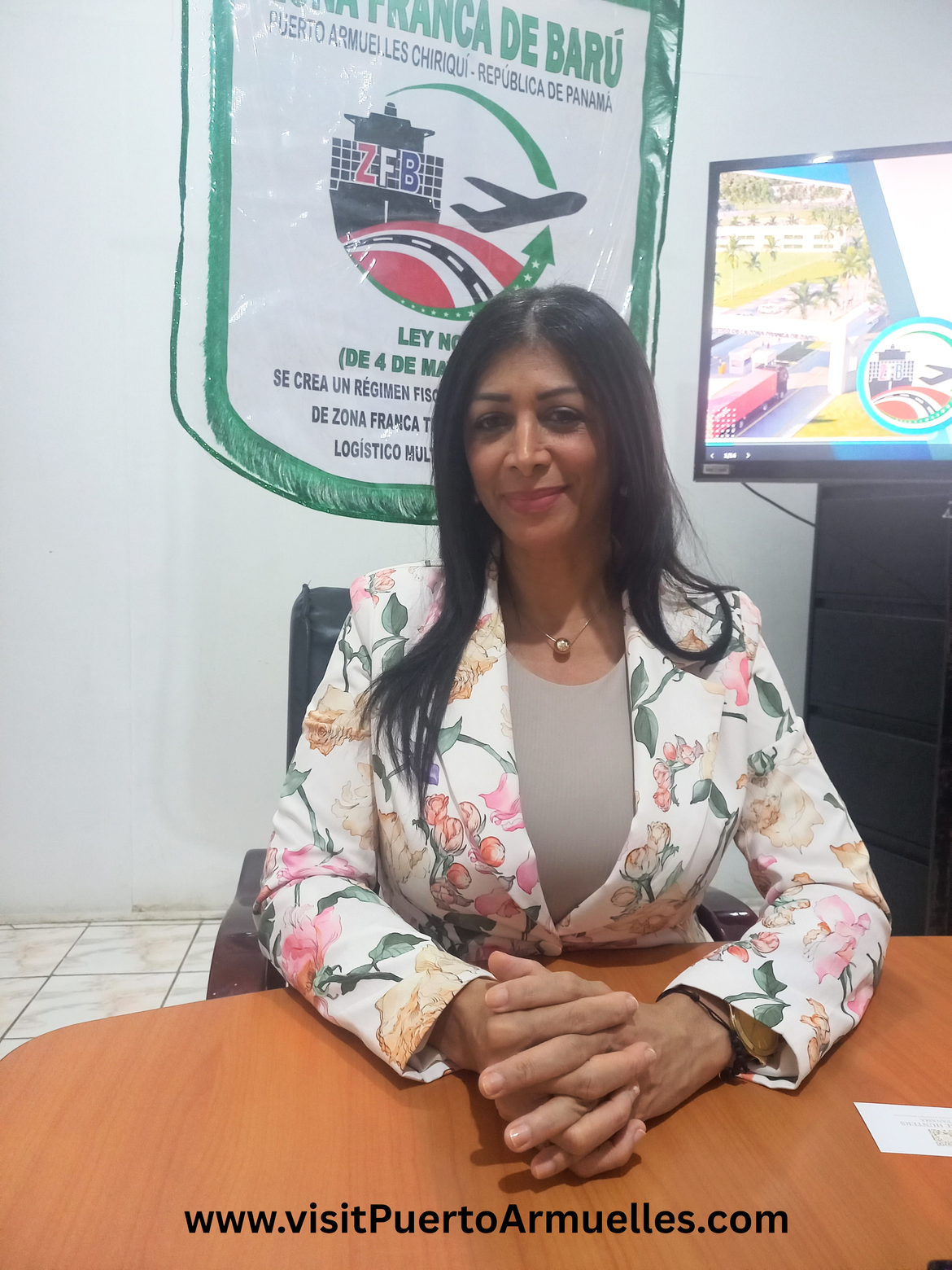
< Click the video above to watch the interview with Zulma Guerra in Spanish. English translation below.
- What are your top three strategic priorities for the Free Zone over the next 2 to 5 years, and how do you plan to measure their success? Regarding the Barú District Free Trade Zone: our primary objective today is to re-engineer an institution that drives results through regulations offering viable fiscal, labor, immigration, and customs benefits for the maritime, tourism, and commercial sectors. We are leveraging the potential of our regulatory framework—which offers viability not just for the local market but for the international market—to achieve this. Over the past seven months as the new manager, I have focused my strategies on establishing the necessary pillars to fulfill this role and offer real alternatives to investors. First, we are ensuring transparency and legal certainty; we are revamping our website so investors can apply directly online, streamlining the process and allowing them to conduct operations without excessive red tape. We aim to create a “single window” system, recognizing that time is a critical factor in logistics. Furthermore, we are developing our own infrastructure to provide small investors with the option of owning their own warehouses in a strategic location. The district operates under free trade zone laws—it is not merely a fenced-in perimeter but a unique environment allowing investors to buy land and build according to their specific needs, thereby creating a tangible asset. We are the only free trade zone offering this alternative: beyond just renting space, we provide the opportunity to create an asset that pays for itself and generates profitability. We are working closely with the logistics ecosystem surrounding the development of the multipurpose port, which will be a cornerstone for moving goods between various strategic points. The district plays a fascinating and vital role, allowing businesses to relocate their operational facilities here and better serve diverse markets. In short, this ecosystem encompasses tourism, commercial development, and other ventures that drive… …fostering the flow of investment and ensuring that profitability is managed transparently, backed by the legal certainty our country offers.
- Which sectors are currently showing the most interest in establishing operations here? Beyond the sectors traditionally present—and the raw material throughput for the multipurpose port, specifically oil palm (which we previously handled via ports in neighboring Costa Rica but will now process using the 16,000 hectares available in the province)—there is the agro-industrial sector. In fact, I recently participated as a panelist in Ecuador, and the Ecuadorian market is keenly interested in leveraging our strategic location and facilities to move their goods; their primary markets are the US and China, but with our port available, they can route their cargo through here to reach the Central American market. We also have the tourism sector; a company is moving forward with a shipyard project here. A shipyard requires demand to sustain operations and staffing, which will create a need for accommodation—such as Airbnb rentals, mini-hotels, and 3-star establishments. Consequently, demand will center on tourism and logistics development, as our port will offer a location where time efficiency is paramount. Regarding the capital city, our port is already seeing strong demand; the Panama Logistics Chamber is currently studying the viability of our logistics ecosystem, recognizing it as a key strategic hub for expanding their operations.
3. What specific incentives are proving most attractive to foreign investors? Incidentally, while I was recently in Ecuador, I had the opportunity to speak with the manager of a Qatari logistics free trade zone located in the capital city. They indicated that the market is highly attractive and noted the immigration incentives we offer: an investor who invests $250,000 in operational activities to establish their business qualifies for a permanent visa. Beyond the permanent visa, we also provide tax incentives; in recent months, I have worked with the General Directorate of Revenue to register companies in the new “2.0” system, allowing them to benefit from all available tax, labor, and immigration incentives.Regarding customs matters, we have also been able to clarify—together with the new Director of Customs—the necessary requirements for companies to, for instance, import their equipment from China and handle the associated taxes. …an annual fee of $800 allows them to enjoy these benefits. However, consider the example of a company conducting agro-industrial operations: it brings in machinery duty-free—machinery that enables it to expand operations and solidify profitability. Thus, the free trade zone offers investors transparency, legal certainty, and a solid incentive framework that allows them to consolidate their operations and expand economically.
- What are the biggest logistical challenges your current operators face, and how is your administration addressing them? We hold a strategic position here—after all, let us remember that Panama represents logistics, a platform, and connectivity; we are strong in that regard. By virtue of this, we possess a “gold mine” in our natural draft. While the Panama Canal has a depth of 16 meters, the port currently under construction here offers a depth of 200 meters—a magnificent natural draft just a short distance away. Post-Panamax vessels can arrive here without any issues. Therefore, our natural draft and strategic position are our greatest assets—aside, of course, from God’s hand, as He is the one enabling us to consolidate this ecosystem we are building. As for current limitations: we are undergoing a re-engineering process. Beyond having the fundamentals—such as a logistics park, a port facility, and an operational port—we also need a land-use plan. This plan must ensure the availability of basic utilities like electricity, water, and connectivity so that when this major impact occurs—a macro-level impact—all basic services are in place. Thankfully, we are already collaborating with the Maritime Authority and universities, and the Ministry of Public Works is also at work. In fact, there is a new tender for 2027 to establish a multimodal air-connectivity system linking us to the Enrique Malek Airport via the Independencia route—a 40-minute journey. This will create a multimodal air-and-land ecosystem, complementing the dual-lane highway and the operational port we already have. We are working hard to achieve this collaboratively, because this is… It is a collective effort involving all the authorities—an undertaking that the free trade zones cannot carry out alone. It requires synergy and close collaboration with the authorities at the Barú Institute and other relevant entities; through this inter-institutional cooperation, we aim to resolve these challenges together and create a viable environment. The goal is to ensure that this initiative not only succeeds in the short term but continues to consolidate over the medium and long term, remaining a successful platform for the area.
Read more about the Baru Free Zone HERE.
Read more about the benefits available to investors in the Baru Free Zone HERE.


