
For years, the Barú Free Zone (Zona Franca de Barú) felt like a sleeping giant. Established under Law No. 19 of 2001 in Puerto Armuelles, it possessed an undeniable geographic jackpot: direct land access to the Costa Rican border and strategic maritime proximity to Central American trade lanes. Yet, a severe lack of physical infrastructure kept it underutilized.
Fast forward to today, and that landscape has completely transformed. Driven by a massive $21.2+ million multipurpose port project backed by the Panama Maritime Authority (AMP) and technical partnerships with major Japanese maritime and logistics corporations, adding an additional $10 million for expansion, Puerto Armuelles is entering a new era.
The warehouse infrastructure within the 50-hectare Puerto Armuelles logistics park is actively pushing towards its updated mid-2027 delivery window. Because operations are scaling up to match this brand-new footprint, a massive demand gap has opened up for agile businesses.
If you are looking to capture early-mover advantages in western Panama, here are the sectors where demand is skyrocketing right now.
1. Multimodal Logistics and Supply Chain Services
With a new pier facility engineered to handle industrial cargo, commercial fishing, and heavy agricultural exports, the region desperately needs businesses that can seamlessly bridge sea, land, and border transit.
-
- Cold Chain and Refrigerated Warehousing: Puerto Armuelles is surrounded by agricultural giants exporting palm oil, bananas, cacao, and premium coffee. Cold storage facilities for handling these perishables before they cross the Paso Canoas border or board a vessel are a critical missing link.
- Freight Consolidation & Cross-Docking: High demand exists for services that can break down bulk cargo arriving from Central America or pack regional products for ocean freight.
- Customs Brokerage and Trade Compliance: Experts specializing in smooth cross-border transit between the Free Zone and the Costa Rican border are essential to keeping the wheels of trade turning.
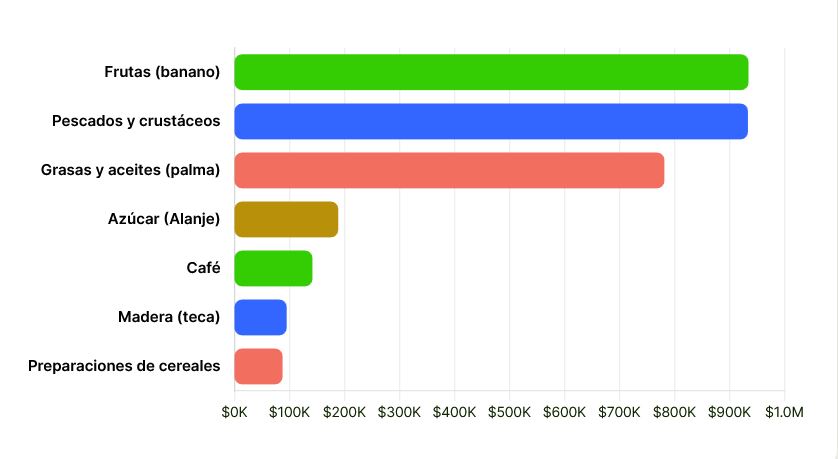
Here are currently the top exports from Chiriquí.
2. Value-Added Agricultural & Seafood Processing
The days of simply shipping out raw materials are shifting. The government’s core focus is boosting local employment by heavily incentivizing “value-added” industries.
-
- Agro-Industrial Packaging & Refining: Setting up light manufacturing plants to process, roast, bottle, or vacuum-pack Chiriquí’s world-class coffee and cacao allows you to leverage the zone’s 0% tax rate on re-exported goods.
- Seafood Processing & Export Operations: Puerto Armuelles has deep historical ties to tuna fleets. Combined with a modern seafood market built alongside the new pier, commercial-scale fish processing, freezing, and canning operations are highly prioritized.
3. Maritime Support and Port Services
As vessel traffic accelerates—bringing in large cargo carriers and commercial fishing fleets—the local port ecosystem requires an immediate network of B2B vendors.
-
- Ship Chandlering and Provisioning: Commercial vessels need to source food, fresh water, fuel, and deck equipment upon arrival.
- Light Marine Repair & Maintenance: Technical workshops catering to commercial fishing boats and specialized port equipment will find a captive market.
4. Eco-Tourism Infrastructure & Commercial Duty-Free Retail
Law 19 didn’t just build a logistics hub; it specifically designated Barú as a Tourism Free Zone to breathe new life into the coastal economy.
-
- Boutique Hospitality and Eco-Lodges: Investors are actively targeted to build beachfront or tourist-focused infrastructure to capture incoming maritime travelers and cruise/yacht arrivals.
- Duty-Free Tourism Retail: Specialty commercial retail shops are authorized to sell tax-free consumer goods directly to international visitors.
5. Specialized B2B Engineering and Technical Services
Because the free zone laws permit a 15% quota framework for foreign experts, there is an immediate business gap for tech-forward companies that can deploy and manage these operations.
-
- Industrial Automation & IT Support: Providing the software and hardware infrastructure for automated logistics hubs.
- Machinery Maintenance Services: Contract technicians specialized in maintaining modern port cranes, bulk packaging machinery, and industrial cold rooms.
- Private Real Estate & Leasing: Acquiring private commercial/industrial land or leasing ready-to-use business spaces through the Panamá Digital Barú Free Zone Registry.
The Cost Advantage: Breaking Down the Numbers
Operating under Law 19 features a highly unique geographical perk: companies can establish operations anywhere within the Barú District, alongside the targeted 50-hectare logistics park.
Because the park’s infrastructure is newly emerging, lease prices represent an aggressive, lower-barrier tier compared to mature, premium zones like Panama City or Colón (where spaces easily command $6.00 to $8.00 per m²).
Expected monthly lease cost estimates per square meter ($/m²) break down into three primary categories:
-
- Raw Land Leases (Concessions): $0.50 to $1.50 per m² / month. This applies if you sign a 20-year concession contract to lease an open lot to construct private, customized facilities (like specialized industrial cold storage or liquid bulk tanks).
- Standard Logistics Warehouses (Galeras): $3.50 to $5.50 per m² / month. This covers standard, turnkey warehouse bays for distribution, freight cross-docking, and general logistics.
- Specialized Refrigerated or Premium Spaces: $6.00 to $9.00 per m² / month. These spaces are built out for agribusiness value-added processing that requires heavy infrastructure, high electrical capacity, or integrated temperature-controlled units.
Hidden Numbers to Factor In:
-
- Maintenance/Common Area Fees (CAM): Usually calculated separately, ranging from $0.25 to $0.60 per m² / month to cover shared park security, solar street lighting, and internal road maintenance.
- Free Zone Administrative Fee: A standard fixed annual operating or registry fee issued by the Free Zone Administration (typically ranging from $2,400 to $2,500 annually for registered corporate users).
The Takeaway
The main trade-off in the Barú Free Zone is lower lease overhead balanced against constructing or adapting your own space as the new port footprint hits its stride. If your business model relies on Central American logistics, agricultural value-adding, or maritime support, Puerto Armuelles is offering a ground-floor opportunity that is hard to ignore.
Read about specific tax breaks & other incentives being offered to investors HERE.
Read the full government report about the Barú Free Zone HERE.
Please follow and like us:


